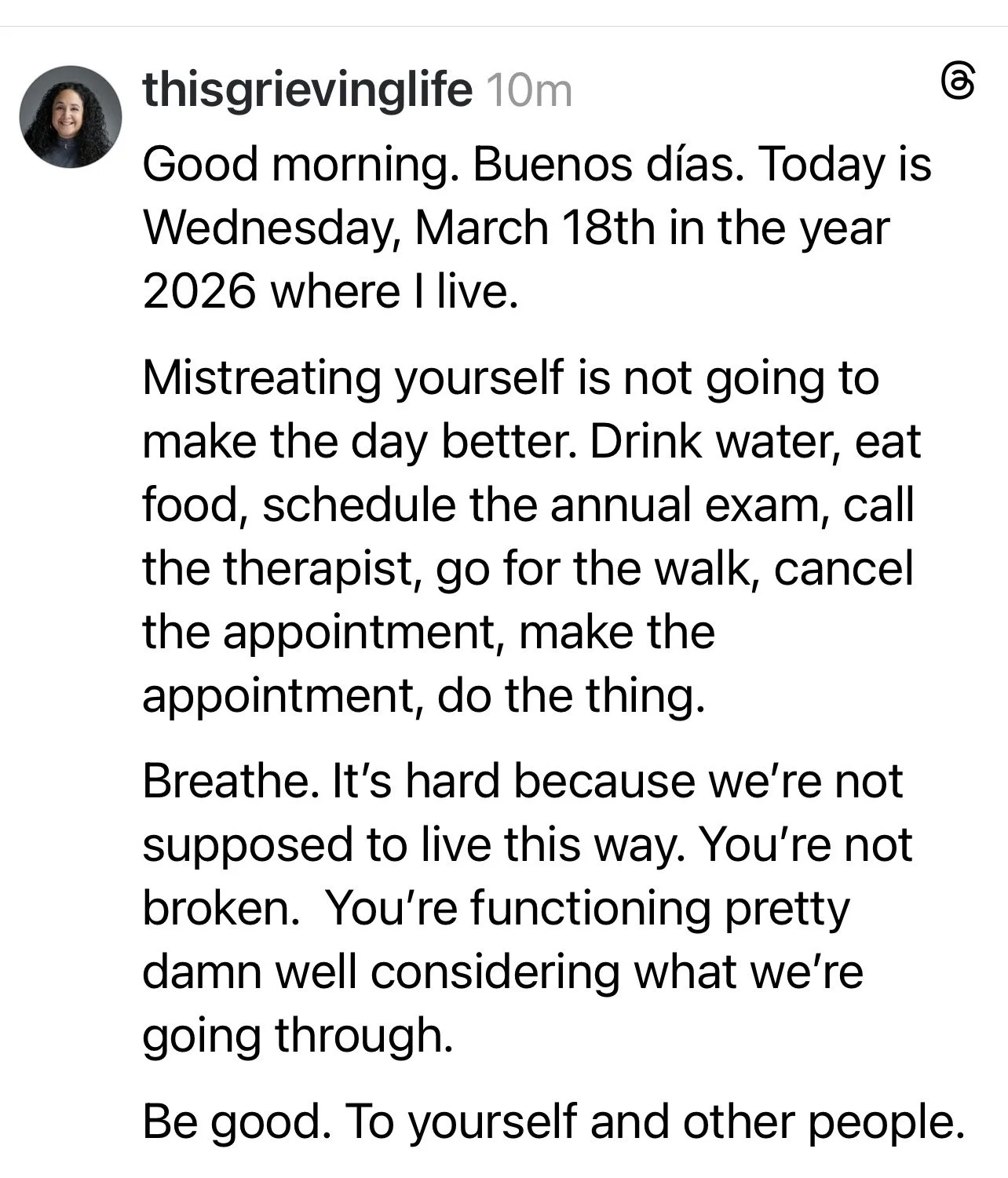
(March 18, 2026)
Mistreating Yourself Is Not Going to Make Today Better
(Ash Wednesday / February 18, 2026)
A Call to Christians in a Crisis of Faith & Democracy
There are moments that call for repentance and resistance, courage and conviction, faith and fortitude. This is one of those moments.
The question is, what will we do now?
We are facing a cruel and oppressive government; citizens and immigrants being demonized, disappeared, and even killed; the erosion of hard-won rights and freedoms; and a calculated effort to reverse America’s growing racial and ethnic diversity– all of which are pushing us toward authoritarian and imperial rule. What confronts us is not only an endangered democracy and the rise of tyranny. It is also a Christian faith corrupted by the heretical ideology of white Christian nationalism, and a church that has often failed to equip its members to model Jesus’s teachings and fulfill its prophetic calling as a humanitarian, compassionate, and moral compass for society.
Therefore, as Christians in the United States, representing the breadth of Christian traditions and one part of our nation’s religiously plural society, we are compelled to speak out more boldly at this time.
We call on all Christians to join us in greater acts of courage to resist the injustices and anti-democratic danger sweeping across the nation. In moments like this, silence is not neutrality—it is an active choice to permit harm.
This call is particularly dire as our nation commemorates the 250th anniversary of the signing of the Declaration of Independence, a time of celebration and reflection on our historic racial and human rights progress and setbacks, as we seek both democratic and civic renewal. Instead, current trends and forces assault our core rights and freedoms and threaten to derail and even destroy our democracy. This is not a distant danger or a future possibility. It is a present and urgent reality.
The government-sponsored cruelty and violence we are witnessing stands in total opposition to the teachings of Jesus. We refuse to be silent while too many people who call themselves Christians aid, abet, or simply stand by and allow these atrocities.
This political crisis is driven by people who have fallen for the temptation of absolute power—undermining democratic checks and balances, entrenching economic inequality, exacerbating divisions, and normalizing corruption and the indiscriminate use of violence.
Freedoms and rights once assumed to be secure are being stripped away, redefined, or selectively applied. Decades-old civil rights protections are being dismantled. Truth is being replaced by lies and propaganda. Governance is being hollowed out and replaced with corruption, loyalty tests, intimidation, and the normalization of lawlessness. The architecture of democracy and the rights secured by the separation of powers are being eroded from within, while we are told to accept it as “law”, “order,” or “God’s will.”
Sadly, the crisis is not only political—it is one driven by a moral and spiritual collapse showing up in alarming levels of polarization.Our faith is being tested. Christians cannot pretend otherwise and must make a decision to act.
We refuse to baptize domination. We refuse to sanctify cruelty. We refuse to confuse authoritarian power with divine authority. We choose to resist, calling forth the righteous demands of our faith rooted in the teachings of Jesus. Religion should not be used to deify politicians or justify their abuses. When it is, faith ceases to be faithful and becomes a weapon of both heresy and hypocrisy.
As Christians, we must never preach nationalism as discipleship, confuse American and Christian identity with whiteness, or mistake allegiance to modern-day Caesars for faithfulness to Christ. We must never surrender our prophetic voice by aligning with powers and principalities rather than with the One who calls us to be purveyors of justice and righteousness.
Now is the time to boldly embrace fidelity to the message of Jesus: to defend the image of God in every person; to love our neighbors -- no exception; to reject retribution; extend grace, mercy, and compassion; reflect the radical counterculture of the Beatitudes and live out the call of Matthew 25 with special care for persons who are poor, vulnerable and marginalized.
As followers of Jesus, we must take these principles seriously, as we seek to renew, deepen, and fortify our faith, resist false religion, build Beloved Community, and become a truly multi-racial, inclusive democracy.
The Sovereignty of God
In every generation, the Church is called to declare without fear or favor, “Thus saith the Lord,” bearing witness to the sovereignty of God over every system, party, and power.
As Christians, our ultimate allegiance belongs to God alone, and we believe that any political leader who demands absolute power places themselves in opposition to God’s sovereignty.
Allegiance to such leaders is idolatry and manipulates the teaching of Jesus as a tool of oppressive power, replacing compassion with control and unity with division. A faithful Christian witness is fundamentally incompatible with nationalist power and the suffering it is producing in our nation and around the world.
The Word of God
We believe that Jesus Christ is the Word of God made flesh. His life and teachings reveal God’s way and must shape our lives, our conduct, and our public witness, especially in this moment. Jesus became human to reconcile us back to God and to one another. This moment is a critical test of our primary allegiance to Him.
Jesus announces His mission in His first sermon: to bring good news to the poor, release to the captives, sight to the blind, freedom to the oppressed, and to proclaim the year of the Lord’s favor (Luke 4:18-19). Any gospel that contradicts this is not the gospel of Jesus Christ.
Jesus teaches in the parable of the Good Samaritan that love of neighbor knows no political, social, or ethnic boundaries (Luke 10:25-37). This love stands in direct opposition to a politics of exclusion and discrimination.
Jesus declares that truth and freedom are inseparable: “You shall know the truth, and the truth will make you free” (John 8:32). Yet, every day we hear lies and distortions that seek to divide and demonize. Truth liberates us from the captivity of lies and brings us into a deeper relationship with God and all others.
Jesus blesses peacemakers, calling them children of God (Matt. 5:9). The Hebrew and Greek words for peace, Shalom and eirene, mean a resolving and restoring of broken relationships. All forms of political violence stand in contradiction to the way of Christ, and Christians must reject them at every turn.
Jesus gives His final test of discipleship in Matthew 25:31-46, making clear that the measure of our faith is revealed in how we treat those who are hungry, thirsty, sick, strangers, or imprisoned. To say, as some do, that this passage is only about taking care of fellow Christians is an incorrect theological interpretation. It is for the nations, ethnoi, for all peoples. This passage names people who are, even now, being directly and deliberately targeted and harmed by those in political power. To serve and defend the most vulnerable is to serve and defend Christ Himself.
The Spirit of God
In this moment, we believe the Holy Spirit is moving us to stand, speak, and act with greater courage to serve the most vulnerable and advance God's reign of justice and peace.
Therefore, we commit to:
Protect and Stand With Vulnerable People: We will defend immigrants, refugees, people of color, and all who are in harm's way; resist cruel, unjust, and illegal policies and violent enforcement, and surround those under attack with pastoral care, solidarity, and prophetic public witness.
Love Our Neighbors: In obedience to Jesus, we will love our neighbors without exception, especially those who are different from us, and reject the politics of fear, exclusion, and dehumanization. We will reject the language of “others” and “us and them,” and remember that Christ came "so that [we] may all be one" (John 17:21).
Speak Truth to Power: We will confront lies and hatred towards immigrants, people of color, Jews, Muslims, and other religious minorities and political opponents; oppose the rollback of civil rights and racial justice protections; name racism as a sin from which we must repent and turn from; and resist the erasure of history and truth. Silence in this moment is complicity.
Seek Peace: We commit to persistently building peace and pursuing justice, including by acting nonviolently to protect those threatened by violence and advocating for a foreign policy that favors diplomacy, respects national sovereignty, and supports democracy, human rights, humanitarian aid, and peacebuilding.
Do Justice: Guided by the prophets, we will challenge unjust laws, defend poor and marginalized people, and persist in the work of uprooting racism and white Christian nationalism. We will commit to act justly, love kindness, and walk humbly with God (Isa. 10:1; Micah 6:8).
Strengthen Democracy: Honoring the image of God–imago dei–in every person (Gen. 1:26) in a democracy means each person's vote is their voice. We will, therefore, defend the right to vote, resist voter suppression and intimidation, encourage greater participation in our democratic process, and equip clergy and lay leaders to support free and fair elections. We will defend constitutional rights and freedoms, including speech and assembly, due process, the rule of law, and religious liberty, and will uphold democratic norms and practices.
Practice Hope: In a time of fear, intimidation, and despair, we will choose hope, which is more than optimism. It is trusting and believing that God is still at work. "Faith is the substance of things hoped for, the evidence of things not seen”(Heb. 11:1).
Ground our Discipleship: Knowing that following Jesus in this time requires deep wellsprings of spiritual courage, we will be rooted and grounded in prayer and love (Eph. 3:17-19), developing practices and commitments to nurture resilience in our inward journey for the outward witness we embrace as our calling.
Choosing Faithfulness
“Choose you this day whom you will serve.”—Joshua 24:15
Faith and democracy do not die in a single moment; they erode when we trade courage for conformity, substitute the gospel for power, and fall silent in the face of wrongdoing.
This letter is made in a spirit of humility and solidarity. It is an invitation for each of us to ask what faithfulness to Christ and love of neighbor demand of each of us at such a time as this.
If we as Christians fail to speak and act now—clearly, courageously, and prophetically—we will be remembered not only for the injustices committed in our time, but for the righteous possibilities we allowed to die in our hands. History and future generations will record our choices, but the God of heaven and earth will judge our faithfulness.
Now is the time to take risks for the sake of the Gospel and our democratic rights and freedoms.
We call on Christians to remember that we serve a mighty and awesome God, who is sovereign over nations and rulers.
We serve a God, through our Lord and Liberator Jesus Christ, who equips us with the courage and fortitude to stand for justice and peace. We will always stand in solidarity with those who are most vulnerable among us.
Now is the time to speak and act.
May God guide us, empower us, and strengthen us.
(January 28, 2026)
This is What Love for God and Neighbor Sounds Like:
Bruce Springsteen’s “Streets of Minneapolis”
Through the winter’s ice and cold
Down Nicollet Avenue
A city aflame fought fire and ice
‘Neath an occupier’s boots
King Trump’s private army from the DHS
Guns belted to their coats
Came to Minneapolis to enforce the law
Or so their story goes
Against smoke and rubber bullets
In the dawn’s early light
Citizens stood for justice
Their voices ringing through the night
And there were bloody footprints
Where mercy should have stood
And two dead left to die on snow-filled streets
Alex Pretti and Renee Good
Oh our Minneapolis, I hear your voice
Singing through the bloody mist
We’ll take our stand for this land
And the stranger in our midst
Here in our home they killed and roamed
In the winter of ’26
We’ll remember the names of those who died
On the streets of Minneapolis
Trump’s federal thugs beat up on
His face and his chest
Then we heard the gunshots
And Alex Pretti lay in the snow, dead
Their claim was self defense, sir
Just don’t believe your eyes
It’s our blood and bones
And these whistles and phones
Against Miller and Noem’s dirty lies
Oh our Minneapolis, I hear your voice
Crying through the bloody mist
We’ll remember the names of those who died
On the streets of Minneapolis
Now they say they’re here to uphold the law
But they trample on our rights
If your skin is black or brown my friend
You can be questioned or deported on sight
In chants of ICE out now
Our city’s heart and soul persists
Through broken glass and bloody tears
On the streets of Minneapolis
Oh our Minneapolis, I hear your voice
Singing through the bloody mist
Here in our home they killed and roamed
In the winter of ’26
We’ll take our stand for this land
And the stranger in our midst
We’ll remember the names of those who died
On the streets of Minneapolis
We’ll remember the names of those who died
On the streets of Minneapolis
(January 16, 2026)
Everyone should read Eugene Peterson’s Introduction to The Message translation of the Bible! Here it is:
Reading is the first thing, just reading the Bible. As we read we enter a new world of words and find ourselves in on a conversation in which God has the first and last words. We soon realize that we are included in the conversation. We didn't expect this. But this is precisely what generation after generation of Bible readers do find: The Bible is not only written about us but to us. In these pages we become insiders to a conversation in which God uses words to form and bless us, to teach and guide us, to forgive and save us.
We aren't used to this. We are used to reading books that explain things, or tell us what to do, or inspire or entertain us. But this is different. This is a world of revelation: God revealing to people just like us—men and women created in God's image—how God works and what is going on in this world in which we find ourselves. At the same time that God reveals all this, God draws us in by invitation and command to participate in God's working life. We gradually (or suddenly) realize that we are insiders in the most significant action of our time as God establishes his grand rule of love and justice on this earth (as it is in heaven). "Revelation" means that we are reading something we couldn't have guessed or figured out on our own. Revelation is what makes the Bible unique.
And so just reading this Bible . . . and listening to what we read, is the first thing. There will be time enough for study later on. But first, it is important simply to read, leisurely and thoughtfully. We need to get a feel for the way these stories and songs, these prayers and conversations, these sermons and visions, invite us into this large, large world in which the invisible God is behind and involved in everything visible and illuminates what it means to live here—really live, not just get across the street.
As we read, and the longer we read, we begin to "get it"—we are in conversation with God. We find ourselves listening and answering in matters that most concern us: who we are, where we came from, where we are going, what makes us tick, the texture of the world and the communities we live in, and—most of all—the incredible love of God among us, doing for us what we cannot do for ourselves.
Through reading the Bible, we see that there is far more to the world, more to us, more to what we see and more to what we don't see—more to everything!—than we had ever dreamed, and that this "more" has to do with God.
This is new for many of us, a different sort of book—a book that reads us even as we read it. We are used to picking up and reading books for what we can get out of them: information we can use, inspiration to energize us, instructions on how to do something or other, entertainment to while away a rainy day, wisdom that will guide us into living better. These things can and do take place when reading the Bible, but the Bible is given to us in the first place simply to invite us to make ourselves at home in the world of God, God's Word and world, and become familiar with the way God speaks and the ways in which we answer him with our lives.
Our reading turns up some surprises. The biggest surprise for many is how accessible this book is to those who simply open it up and read it. Virtually anyone can read this Bible with understanding. The reason that new translations are made every couple of generations or so is to keep the language of the Bible current with the common speech we use, the very kind of language in which it was first written. We don't have to be smart or well-educated to understand it, for it is written in the words and sentences we hear in the marketplace, on school playgrounds, and around the dinner table.
Because the Bible is so famous and revered, many assume that we need experts to explain and interpret it for us—and, of course, there are some things that need to be explained. But the first men and women who listened to these words now written in our Bibles were ordinary, everyday, working-class people. One of the greatest of the early translators of the Bible into English, William Tyndale, said that he was translating so that the "boy that driveth the plough" would be able to read the Scriptures.
One well-educated African man, who later became one of the most influential Bible teachers in our history (Augustine), was greatly offended when he first read the Bible. Instead of a book cultivated and polished in the literary style he admired so much, he found it full of homespun, earthy stories of plain, unimportant people. He read it in a Latin translation full of slang and jargon. He took one look at what he considered the "unspiritual" quality of so many of its characters and the everydayness of Jesus, and he contemptuously abandoned it. It was years before he realized that God had not taken the form of a sophisticated intellectual to teach us about highbrow heavenly culture so we could appreciate the finer things of God. When he saw that God entered our lives as a Jewish servant in order to save us from our sins, he started reading the book gratefully and believingly.
Some are also surprised that Bible reading does not introduce us to a "nicer" world. This biblical world is decidedly not an ideal world, the kind we see advertised in travel posters. Suffering and injustice and ugliness are not purged from the world in which God works and loves and saves. Nothing is glossed over. God works patiently and deeply, but often in hidden ways, in the mess of our humanity and history. Ours is not a neat and tidy world in which we are assured that we can get everything under our control. This takes considerable getting used to—there is mystery everywhere. The Bible does not give us a predictable cause-effect world in which we can plan our careers and secure our futures. It is not a dream world in which everything works out according to our adolescent expectations—there is pain and poverty and abuse at which we cry out in indignation, "You can't let this happen!" For most of us it takes years and years and years to exchange our dream world for this real world of grace, mercy, sacrifice and love, freedom and joy—the God-saved world.
Yet another surprise is that the Bible does not flatter us. It is not trying to sell us anything that promises to make life easier. It doesn't offer secrets to what we often think of as prosperity or pleasure or high adventure. The reality that comes into focus as we read the Bible has to do with what God is doing in a saving love that includes us and everything we do. This is quite different from what our sin-stunted and culture-cluttered minds imagine. But our Bible reading does not give us access to a mail-order catalog of idols from which we can pick and choose to satisfy our fantasies. The Bible begins with God speaking creation and us into being. It continues with God entering into personalized and complex relationships with us, helping and blessing us, teaching and training us, correcting and disciplining us, loving and saving us. This is not an escape from reality but a plunge into more reality—a sacrificial but altogether better life all the way.
God doesn't force any of this on us: God's Word is personal address, inviting, commanding, challenging, rebuking, judging, comforting, directing—but not forcing. Not coercing. We are given space and freedom to answer, to enter the conversation. For, more than anything else, the Bible invites our participation in the work and language of God.
As we read, we find that there is a connection between the Word Read and the Word Lived. Everything in this book is live-able. Many of us find that the most important question we ask as we read is not "What does it mean?" but "How can I live it?" So we read personally, not impersonally. We read in order to live our true selves, not just get information that we can use to raise our standard of living. Bible reading is a means of listening to and obeying God, not gathering religious data by which we can be our own gods.
You are going to hear stories in this book that will take you out of your preoccupation with yourself and into the spacious freedom in which God is working the world's salvation. You are going to come across words and sentences that stab you awake to a beauty and hope that will connect you with your real life.
Be sure to answer.
(December 12, 2025)
Give These People a Wide Berth
In the conclusion to his magnum opus, the Apostle Paul writes to the followers of Jesus in Rome, “I urge you, brothers and sisters, to watch out for those who cause divisions and put obstacles in your way that are contrary to the teaching you have learned. Keep away from them. For such people are not serving our Lord Christ, but their own appetites. By smooth talk and flattery they deceive the minds of naive people.”
Eugene Peterson’s translation puts it this way:
One final word of counsel, friends. Keep a sharp eye out for those who take bits and pieces of the teaching that you learned and then use them to make trouble. Give these people a wide berth. They have no intention of living for our Master Christ. They’re only in this for what they can get out of it, and aren’t above using pious sweet talk to dupe unsuspecting innocents.
I have often wondered what Paul would write to followers of Jesus living in the United States in our present moment, and who he would be warning us about.
While I can’t speak for the Apostle Paul, as a fellow “honorably retired” Presbyterian minister, I am confident that Eugene Peterson would have singled out these folks, among others. And I most certainly do.
Friends, GIVE THESE PEOPLE A WIDE BERTH. They have no intention of living for our Master Christ. They’re only in this for what they can get out of it, and aren’t above using pious sweet talk to dupe unsuspecting innocents.
May the Lord have mercy on them, may He protect them from themselves, and may He protect the rest of us from their evil influence in our time and place.
(October 22, 2025)
The Evangelistic Need of Our Day: Disentangling Christ from MAGA Christianity
[This is a timely article by my friend, Rev. Dr. Justin Adour, pastor and co-founder of Redeemer East Harlem, that can be found at their Until Zion site.]
Over the weekend, I again helped lead a group of Christians from various churches—through a non-profit of which I am the Executive Director, Pray March Act—in the No Kings event in NYC. In case you are not aware, No Kings is a movement demanding that our current administration remember they are mere stewards of our Constitution, laws, and system of government—not authorities unto themselves. For what it is worth, despite what some might claim, we are not antifa, Marxists, paid actors, or haters of the United States. We love our nation.
However, the continued unilateral decision-making, extrajudicial killings with weak or non-existent justifications, constant fear-mongering and blame-shifting (including the endless “whataboutisms”), the excessive force and inhuman treatment used in immigration enforcement, the ignoring or marginalizing of the judicial process, the use of government agencies for personal gain or vanity, the demands for loyalty over almost any other standard, and so much more, have been egregious abuses of power. Of course, we know President Trump is not actually a king, but many believe his posture and assumptions continue to erode our constitutional republic. That said, the specific issues with the Trump administration are for another day and, frankly, for others to expound.
The Evangelistic Need of Our Day
Yet, what strikes me is the extent to which, in the midst of the chaos in which we live, we may be missing the evangelistic need of our day. There is a deep and urgent need to disentangle faith in Jesus from MAGA Christianity. When political leaders exalt themselves, especially in ways we have seen recently, Christians must resist by bearing witness to our true King—not only because of the inevitable political corruption, but also because of the spiritual confusion it creates for a watching world.
I was again reminded of how desperately this evangelistic need is through the interactions I have at these rallies. The sign I and others carry, which says, "The only King we serve is our Lord & Savior Jesus Christ," gets a lot of attention. During these rallies, I have countless conversations with people who say things like, “Thank you for marching with that sign,” or “I didn’t think Christians cared about this,” or “I disagree with you theologically, but I appreciate what you’re saying.” For me, protesting and activism have always been part of what it means to be a faithful Christian. But, for many, when they come across a Christian in these settings, it’s as if they’ve stumbled upon a unicorn. Why?
For many, there’s an assumption that Christianity—and, in particular, evangelical Christianity—is MAGA Christianity. Frankly, at this point, I’m not even sure what “evangelical” means anymore. So maybe they’re correct. But while the sign signals how evangelicals tend to talk about their faith—that is, perhaps the most standard evangelical purity test is the extent to which one claims “Jesus is my Lord and Savior”—it also reflects the faith I claim. I am, in nearly every way, theologically and, in many ways, socially conservative. I will save you the reflection, but I could list off all the conservative credentials and commitments I hold.
But the point is simply this: I would absolutely be categorized as a conservative evangelical Christian in the way that category has been historically used. One would be hard-pressed to find a belief in my convictions that do not align with historic, conservative Christianity. And most importantly, my evangelical convictions mean I want people to come to a saving knowledge of Jesus through repentance and faith, as He is the only way of salvation. I want to see people, including myself, submit their lives—body and soul—wholly to Him and live as though He truly is Lord and Savior. Yet—and here is the main point—for many in our current landscape, being a Christian also means submitting to a MAGA version of Christianity. The two have become the same.
Claims of Faith
Additionally, a real issue is also that not everyone who claims “Jesus is Lord and Savior” or says that "Jesus is King" actually believes those claims. Such claims mean nothing if they are mere words. We are reminded in one of the most haunting passages of Scripture, that some will stand before Jesus with claims of working in His name only to hear Him say, “‘I never knew you. Away from me, you evildoers!’” (Matt. 7:23). This ought to be a sobering passage for us all. It is not enough to say that Jesus is King. We can attach the name of Jesus to anything we want, claiming we are doing His work, but it will be the conduct of our lives, the quality of our character, and the posture of our hearts that will prove whether or not we know Jesus. This is the case for me and anyone who claims the name of Jesus.
Relatedly, my concern is that there is much being written about a revival happening in our nation. However, those claiming this revival often view the rise of a MAGA-style Christianity as proof of that revival. I’m not entirely sure what to make of those claims, and I think time will tell which seeds ultimately have landed on rocky soil or among thorns. I do wonder the extent to which many are claiming the name of Jesus, and even claiming to work in His name, yet in the end, it will be shown that Jesus knows them not. But while such sorting of the sheep and goats is a task for God alone, what I do know is that there are those appalled by this administration who desperately need to know that faith in Jesus is not a faith in MAGA Christianity. Again, this is the evangelistic need of our day.
Disentangling Faith
What do we want people to believe about Jesus? Jesus Christ is King and Lord over all. One day, every knee will bow and every tongue will confess that He is Lord. As our Creator King, He demands that we turn from our sin and rebellion against Him and instead submit every area of our lives to Him. For not only is He King, but He is also Judge—the One before whom we will one day give an account. Yet, out of love for us, Jesus Christ has taken upon Himself the consequences of our sin and rebellion against God. Through this grace, for those who trust in Him for their salvation, when we one day stand before that judgment throne, we can have confidence that it will not be our works that save us, but the work of Jesus on our behalf. And in that knowledge, we can trust that the Spirit of God will sanctify us so that our lives more and more reflect the holiness, righteousness, and purity of Jesus.
That, however, is wholly different from a MAGA-Christianity that attaches those beliefs to propping up, promoting, and even, at times, venerating an administration and movement that is so often antithetical to the nature and character of Christ and His Kingdom. And in case it needs to be said, I also agree that there is much on the other end of the political spectrum that is antithetical to the nature and character of Christ and His Kingdom. The difference is that only one end has attempted to co-opt Christ and the evangelical faith.
For many reading this article, you are also feeling the weight of fighting a battle on two fronts. On one front, we want to reach those—like the people I meet at these rallies—who need to hear about Jesus detached from MAGA Christianity. We want them to know Jesus. On another front, we want those who have conflated Jesus with a brand of conservative politics to detangle their faith. We also want them to know Jesus. I long for them to one day hear Jesus say, “Well done, my good and faithful servant,” and not, “Depart from me, I never knew you.” Again, I do not know for sure who is who. Only the Lord knows those who have experienced genuine conversion. But what I do know is that MAGA Christianity is clouding clarity about who Jesus is.
Ultimately, let our allegiance and submission to Christ be so clear that no one can mistake our faith for a political movement.
Father, give us grace, wisdom, and courage to make clear the message of Christ’s life, death, and resurrection to those in need of His redemption. And guide us through the fog of these current days that we might present Christ clearly and holistically to all in need of His saving grace.
(October 12, 2025)
On the Occasion of Being Granted “Honorably Retired” Status as a Presbyterian Minister
This past week I requested and was granted “Honorably Retired” Status as a Presbyterian Minister [for the policy wonks among us, cf. ECO Constitution Chapter 2.0401(g)], in large part to free up more bandwidth for our ministry with House of Mercy. I don’t know how much this distinction means to others, but after more than 31 years as an ordained minister of the Gospel it means a great deal to me.
One of the lectionary readings in church this morning was this section from Psalm 66:
8 Bless our God, O peoples,
let the sound of his praise be heard,
9 who has kept us among the living,
and has not let our feet slip.
10 For thou, O God, hast tested us;
thou hast tried us as silver is tried.
11 Thou didst bring us into the net;
thou didst lay affliction on our loins;
12 thou didst let men ride over our heads;
we went through fire and through water;
yet thou hast brought us forth to a spacious place.
I am very conscious of the fact — after more than 31 years of passing through both fire and water in the ministry — that it is the Lord in His kindness and faithfulness who “has not let my feet slip;” that it is the Lord Jesus who has “yet brought me forth to a spacious place” — the spacious place of honorable retirement. In light of that, I thought that today might be an especially appropriate time to post a chapter that the seminary associated with my denomination asked me to write several months ago. I hope you will find this encouraging.
FLOURISH INSTITUTE OF THEOLOGY BOOK OF LETTERS: Wisdom and advice for seminarians, in the spirit of Paul’s letters to Timothy
I have served as a Presbyterian pastor for over thirty years. I have not been a Presbyterian pastor, I have served as one. More on that distinction later.
My wife and I had lunch a few weeks ago with a close friend, a young man about to begin his service as the pastor of a historic Presbyterian congregation. I have the privilege of serving as one of his official mentors for ministry. Knowing many of the details of my life in the church, he asked me, “All of those attacks you have endured as a pastor . . . why didn’t you just quit? How have you stuck in there?” This essay -- really more a collection of vignettes than an essay -- is an attempt to answer that question, an attempt to encourage him and you, wherever and whenever you may be reading this.
*******
The first thing I want to say is thank you. Thank you for receiving the breathed-out Holy Spirit from Jesus and answering his call to serve him as an ambassador of reconciliation and grace in this “present evil age,” where principalities and powers are everywhere victorious. Faithful ministers of the gospel are as needed now as they ever have been and ever will be. May God bless you with every blessing in Christ, both now and for the whole of your life.
I graduated more than forty years ago, with 660 fascinating classmates from an outstanding public high school in suburban Washington, D.C. While just a small handful of us went on to serve in the military (as I did), there was another form of service that only one of us took on: Becoming a member of the clergy. One of my classmates and friends, a Hollywood screenwriter and director, calls me every so often, “Hutch, since you’re the only religious person I know I’m wondering if you can help me. I’m working on a script that has a religious character; can you tell me if this dialogue is realistic?”
Religious faith is a strange thing, especially to those viewing it from the outside. Serving as a member of the clergy -- and, more specifically, as a minister of the good news of Jesus Christ, is an exceedingly strange thing. And that is the point. The moment it becomes “normal” or “safe” is the moment it loses all meaning and value.
*******
Here is my first piece of advice. Do not lose yourself. A calling to the ministry is just that, a calling, not an identity. Do not get lost in your calling. The precise reason you were called -- you, and not someone else -- is because God made you, you. Frederick Buechner’s words are delightful, “The grace of God means something like: Here is your life. You might never have been, but you are because the party wouldn't have been complete without you. Here is the world. Beautiful and terrible things will happen. Don't be afraid. I am with you.”
Many times I almost lost myself inside my calling, intentionally or unintentionally cutting myself off from anyone who did not know me first and foremost as “pastor”; intentionally or unintentionally allowing “pastor” to become who I was, losing my connection to nearly everything throughout my life that the Holy Spirit had used to make me, me. Some pastors -- forgetting the delight God takes in them as his own daughters and sons -- have such an anemic sense of self that they can only conceive of themselves through the eyes of those who view them as “pastor”. I think that is who I may have been at my 20th High School Reunion. But, by God’s grace, it is not who I was by my 40th.
*******
I drove back to my hometown for my 20th High School Reunion as the Senior Pastor of one of my denomination’s largest churches. I had served at three different churches by then, with my title and salary expanding each time. I received inquiries from bigger churches every so often, with one even calling me (humblebrag alert) “one of the most gifted pastors of your generation.” Fast forward to my 40th reunion, this time arriving in the early stages of planting a small house church which meets in our living room. By now nearly sixty years old, almost no one at the reunion needed to impress or be impressed. We simply enjoyed being with each other, each having survived and endured and created so much in the intervening years. And never before had I found more delight in answering my friends’ questions about what I did, about what it meant to serve as a pastor. Do not lose yourself, because to lose yourself is to lose all possibility of joy in your calling.
*******
My second piece of advice. More than advice, really, given that this comes straight from Scripture: Let your gentleness be evident to all. Without gentleness, without love, your ministry is worthless. You know this. Even if you speak in the tongues of angels, even if you can fathom all mysteries and all knowledge, and even if you give all you possess to the poor; without gentleness, without love, your ministry is worthless.
*******
So, here is some of what happened between my 20th and 40th reunions; some of the stories that prompted the question from the young pastor I am mentoring, “Why didn’t you quit? How have you stuck in there?”
What does one do when one discovers that a sister congregation is being taken over by white supremacists from the Aryan Nation? What does one do when their three-year effort to right those wrongs leads to the thirteen elders of their own church calling them to a secret late-night meeting where one is told, “Your efforts against racism are peripheral to the gospel. The only reason we went along with you for the past three years was because you bullied us into it. You are young and idealistic; just wait until your daughter brings home a black man she wants to marry. If you don’t resign voluntarily we have ways of making you resign.”
What does one do when one moves their family to serve a church in Connecticut (surely no white supremacists or misogynists there) only to find that a number of the members believe that the subsequent reelection of Barack Obama meant that faithful Christians should (direct quote alert) “take up arms to overthrow the civil government”? What does one do when one further discovers that the leaders of their church angrily object to sermons teaching that male and female have equal and infinite worth before God?
What does one do when one is recruited to join the staff at a different city and church in Connecticut, and on their first Sunday finds themselves trapped in the sanctuary after the service, standing beside their new Senior Pastor as he screams in anger at a woman who had simply approached him to ask a question? What does one do when one gradually discovers that “how the sausage is made” at their new church includes decades of manipulation, untruths, deception, illegal theft, hostile threats, spiritual abuse, and malignant narcissism?
What does one do when God graciously thaws them from their years of indifference to a beautiful and important theme in Scripture -- that the Lord calls and empowers his daughters to service and leadership in the Church just as fully as he does his sons -- and one is set free to follow their conscience? What does one do when they answer the new call of God and are then threatened with excommunication for changing their views? And what does one do when they receive hostile communications and certified letters from the denomination they have served faithfully for decades, demanding that they stand trial, even after they have been received into their new denominational home and begun their new ministry adventure?
What does one do when their sponsoring church changes Senior Pastors and ministry philosophies, and then vows to end all support for one’s calling to plant a house church, because of one’s refusal to join the new pastor’s angry and self-righteous culture war against perceived “unbelievers?” What does one do when they are angrily accused of being “a wolf in sheep’s clothing?”
*******
Here is what one does. At least, here is some of what I did, the sorts of practices that my best pastors and mentors taught and modeled for me -- the sorts of practices that help a minister of the gospel to stand firm, to let nothing move them, to always give themself fully to the work of the Lord, because they know that their labor in the Lord is not in vain (1 Cor. 15).
*******
An old joke: Two friends meet up after having not seen each other for many years and the first says, “My friend, how you have changed! Your face used to be etched with worry and your shoulders sloped, but now you are smiling, standing up straight with your head lifted and your face bright as the sun! What has happened?” The second friend answers, “It is the most wonderful thing! I have found someone who does all my worrying for me! He charges me ten million dollars a day, and he does all my worrying for me!” “That is wonderful indeed,” the first friend says, “but where in the world do you find the money to pay him?” The second friend replies, “Well, that’s HIS worry!”
*******
“Come to me, all you who are weary and burdened, and I will give you rest,” the Good Shepherd speaks to your heart in the midst of ministry. “Take my yoke upon you and learn from me, for I am gentle and humble in heart, and you will find rest for your souls. For my yoke is easy and my burden is light.” Faith believes and rests in these words from the Good Shepherd.
And so, better than the silly joke is this: “This is what the kingdom of God is like. A man scatters seed on the ground. Night and day, whether he sleeps or gets up, the seed sprouts and grows, though he does not know how.” Jesus really does give us all we need to keep us gentle and loving through all the attacks and trials of ministry.
*******
Which leads to a third piece of advice: Guard your faith, which is more valuable than gold. Remember that faith is simply resting in the Good Shepherd’s love for you -- and for your congregation, and for the whole world. As our Confession puts it, “The principal acts of saving faith are accepting, receiving, and resting upon Christ alone for justification, sanctification, and eternal life, by virtue of the covenant of grace.”
*******
Jude concludes his letter by saying the same thing: Above all, keep yourself in the love of God.
Put the oxygen mask on your own face first. Rejoice; again I say, rejoice! We know what love is: Jesus Christ laid down his life for us. You have been crucified with Christ, and it is no longer you who live, but Christ who lives in you; and the life you now live in the flesh, you live by faith in the Son of God, who loved you and gave himself for you. He leaps the mountains and bounds the hills to greet you. The joy of the Lord is your strength. Is he, or is he not, the Pearl of Great Price? Have you, or have you not, sold all to acquire him and hold on to him? Keep yourself in the love of God, dear sister or brother. This is how one perseveres in joy.
*******
Nicolaus Zinzendorf had it right about our calling: “Preach the Gospel, die, and be forgotten.”
Eugene Peterson agrees: “At best, we plant seeds. And die. And wait for resurrection.”
Remember that there was no hidden “fine print” whereby he tricked you into the ministry; it has been right there in his breathed-out Word all along: “To this very hour we go hungry and thirsty, we are in rags, we are brutally treated, we are homeless. We work hard with our own hands. When we are cursed, we bless; when we are persecuted, we endure it; when we are slandered, we answer kindly. We have become the scum of the earth, the garbage of the world—right up to this moment.”
You are well aware of this, and in response to the call you have received, your heart is humbly and bravely saying, “Here am I; send me.”
*******
Meanwhile, as Dostoyevsky wrote, “Beauty will save the world.”
Beauty will also save your calling as a pastor. Many times all it takes to begin the reset and recalibration of our hearts is a walk in the woods or around the block, drinking coffee by oneself or with a partner or friend, reading a poem or an essay or an article or a story, listening to music and lyrics or just music, watching a ballet or a ballgame or a story on a screen, gazing at a painting or a sculpture or a baseball card or a Pinterest board or almost any single thing that God has made in nature, eating a simple meal or having one’s thirst quenched, stretching and exercising and breathing in and out deeply and slowly. Our pets. Fish and birds and animals and insects and worms. Gardening and yard work is a gift. A comfortable chair, a clean sheet of paper, a working pen, a cushioned pair of shoes. A knit hat. A rum cake. Sleep is a gift. Give thanks for sleep whenever God grants it, and give thanks for each new day of ministry, each new day of hearing Jesus say to you, “Come, follow Me.”
*******
“God, designing Eden, puts in trees. The first thing the verse tells us is that they’re ‘pleasant to the sight.’ Only after that are we told that they provide good things to eat. Robinson notes that God gave us the gift of enjoyment—which was ‘nothing less than a sharing of His mind with us.’”
~ From Judith Shulevitz’s review of Marilynne Robinson’s, Reading Genesis
*******
Walker Percy wrote about waking up to a new day, “One discovers, one is not dead! One is alive! One is free! One feels, What the hell, here I am washed up, it is true, but also cast up, cast up on the beach, alive and in one piece. The possibilities open to one are infinite. Why not get up and begin exploring?”
*******
“So many gifts. What do they mean?”
~ Mary Oliver
*******
“His mercies are new every morning. What do they mean?”
~ J. D. Hutchinson
*******
The formula is not rocket science: He must increase and you must decrease.
What good news this is! It is not by chance that the proverb, “God gives grace to the humble, but opposes the proud” is repeated over and over by the gospel writers, by Paul, by Peter, by James. It is possibly the most often quoted Old Testament verse in the New Testament. What good news for the one called to the ministry of the gospel!
Unless a seed falls to the ground and dies, it can bear no fruit. In order to save your life, you must lose it. You know this!
*******
You also know this, that compared to the surpassing worth of knowing Christ, everything else that you might want to boast in should be considered garbage. You know that gaining Christ, and being found in him, is worth far more than every other good, true, and beautiful thing put together. The calling to the ministry is a calling to be in that place where one experiences both the power of Christ’s resurrection and a participation in his sufferings, becoming like him in his death. These experiences make us even more fit for the Life of the World to Come. They are worth more than anything else this present age can offer.
*******
Finally, another old joke:
Once upon a time there was a famous U.S. Navy Captain who had led ships into battle, through canals, across oceans, into and out of ports all around the world. He was admired by his crew and fellow senior officers, even though he had one eccentric habit. Every morning he would retreat to his cabin and open the safe and take out the same small piece of paper and read it, and then place it back into the safe. This habit became well known, and so of course the crew was curious. One day his Executive Officer finally got up the courage simply to ask him, “Captain, what is that piece of paper? Is it orders from the Admiral? A top secret Battle Plan? A love letter from home? What is it? What does it say?” So the Captain showed it to him. It read, "Left is Port, Right is Starboard.”
*******
What is your “Left is Port, Right is Starboard”? What are the simple truths that you know you must never forget, that will keep you on course through all the storms of ministry and of life? You have been called to humble yourself as a pastor, as a servant of the good news of Jesus Christ, but that is not who you are. After all, if Jeremiah 31:33-34 is to be believed, there won’t be any pastors in the Life of the World to Come, so who will you be then if your calling in this present age is the sum total of who you are?
Your present calling will come with great difficulties and great delights, joyful successes and paralyzing losses, both deaths and resurrections, but who you are is not tied up in any of that. Who you are is your port and starboard. And this is who you are: A beloved child of God, shining like a star in the sky in the midst of a world that is in great need of you. The party cannot be complete without you.
God bless you, my fellow shepherd and fellow servant of Christ Jesus, the Good Shepherd of the sheep.
~ Jeff Hutchinson, House of Mercy, New Haven, Connecticut